

Are you worried about a tree?
Assess the risk before deciding
Has a branch broken, is a tree leaning more than usual, or has a crack or fungus appeared at its base? Before deciding to cut it down, it's essential to determine if the danger is real. An independent assessment allows for an objective evaluation of the risk and helps in choosing the most appropriate course of action, without either dramatizing or minimizing the situation.
In case of immediate danger
If a tree or large branch threatens to fall on a road, a house, or people, for example after a storm: move people away, mark off the area if possible, and notify emergency services or your local council. Do not attempt to remove the tree yourself. Once the situation is secure, we can carry out the assessment.
Warning signs
- A new or increasing inclination, especially if the ground is heaving or cracking on the opposite side.
- Mushrooms at the base, on the roots or on the trunk: they often indicate wood rot.
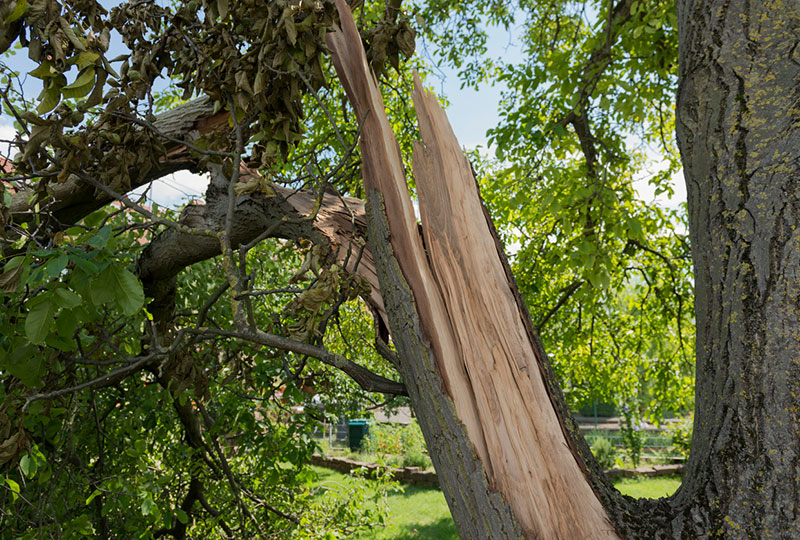
- A crack or a split on the trunk or at the base of a main branch.
- A cavity, peeling bark or abnormal drainage.
- Dead wood in the canopy, broken or hanging branches after a gust of wind.
- Recent work nearby: trenching, earthworks, change in ground level.
A striking defect doesn't necessarily mean the tree is dangerous; trees often compensate for their weaknesses. Conversely, a subtle defect can be a sign of impending breakage. Only careful examination can tell the difference.
How we intervene
Tree assessment — Observation of the tree and its environment according to the VTA method, to understand the origin and evolution of the defect.
Risk assessment — When people or property are exposed, the risk is quantified according to the QTRA method (registered user no. 11171) and compared to recognized thresholds.
Recommendations — Monitoring, pruning, bracing, site use adjustment or, as a last resort, felling: the measure is proportionate to the actual risk and accompanied by a time limit.
Our firm does not carry out any work: you are free to entrust the work to the company of your choice.
Who is responsible for a dangerous tree?
Generally, the owner of a tree is responsible for any damage it may cause, including damage to a neighbor's property or to public roads. A dated expert report demonstrates that the tree has been examined and that the necessary measures have been taken. In case of disagreement with a neighbor, it provides an objective and independent perspective.
Frequently Asked Questions
Should a leaning tree be cut down? — Not necessarily. Many trees have always grown at an angle and are stable. It's a recent or changing inclination that should raise concern.
My neighbor thinks my tree is dangerous. What should I do? — An independent diagnosis allows for an objective decision and avoids a conflict based on an impression.
Can I send you some photos? — Yes, via the contact form : they help us to assess the urgency before the visit.
Dangerous tree
Any doubts about a tree? Let's talk about it.
Describe the situation to us, with photos if possible: we will assess the urgency and propose the appropriate mission, with a detailed, no-obligation quote.